The Final Link: The Conception of The Century Freeway
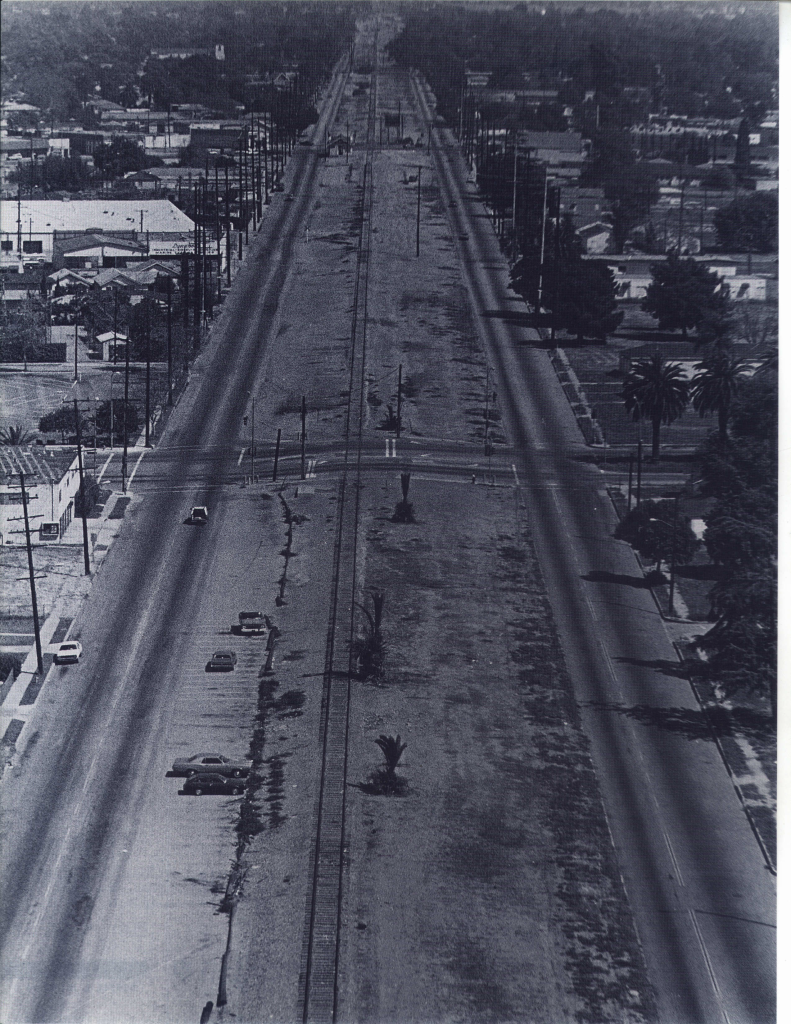
The State of California had begun to accumulate a type of expertise in the world of highway development by the time that the Century Freeway was conceived. The State was forced to continue coming up with creative solutions on the financing and development front as the Century project advanced. In “California’s Freeway Era in Historical Perspective”, Jones Jr. identifies a number of tactics conceived of and/or perfected by the State:
- The use of the gasoline tax to finance a sustained program of urban freeway construction
- The assignment of urban construction duties to the state highway department
- The upscaling of urban parkways into metropolitan freeways
- The standardization of geometric design
- The mass production of freeways to high standards under the auspices of a state-wide engineering organization
To be clear, not all plans for highway development in California originated at the State-level. Los Angeles’ ambitious City Engineer Lloyd Aldrich originally envisioned a 612-mile system of “limited access facilities” which would today be known as freeways. However, when The Great Depression and war began to slow access to Federal funding, the Division of Highways was reluctant to commit to projects beyond the Arroyo Seco parkway which opened to traffic in 1940 because right-of-way acquisitions would be “prohibitive from the standpoint of the State’s financial ability to pay.”
The State Division of Highways would change its tune shortly thereafter when the Defense Highway Acts of 1941 and 1943 lured the agency back into a leadership position after Federal funds were made available for right-of-way acquisition and for engineering surveys for highway projects that could go into effect at the conclusion of the war. After the way, it was believed that steel and concrete would finally be available again which would allow construction to commence. California took advantage of this head started and with the Collier Burns Act of 1947, DOH was committed to building 475 miles worth of freeways in Los Angeles and San Francisco at a cost of $750 million with an additional $500 million available for right-of-way acquisitions. The actual funding necessary to see through these commitments became available when the state implemented a gas tax in 1953 and when Congress voted to fund the Interstate Highway Program on June 26th, 1956. With cash in tow, securing the necessary engineering manpower and orchestrating the necessary right-of-way activities became the primary constraints for executing the State’s ambitious plans.
It took a really, really long time to get The Century Freeway built and open for traffic. Consider this, as far back as December 1958 notices were sent to governmental agencies throughout the region informing them that the State would begin studying what the impacts of a route would be. In 1959, what would become the Century Freeway was incorporated into the California Freeway and Expressway System. In the mid to late 1960s, the California Highway Association worked to adopt routes after conducting numerous meetings and hearings related to route impact. Early beliefs were that the freeway could be operational by 1977.
By and large, there was agreement amongst agencies that a freeway was needed to help alleviate some of the challenges presented by heavy congestion on roads like Century Boulevard. Was the route that would ultimately be targeted for the freeway one that represented the path of least resistance? Maybe so. Maybe not. Regardless of which characteristics were being sought out by planner, there simply weren’t any affluent communities along the chosen path that would be able to mount a sufficiently strong campaign against the freeway. In fact, the residents of the corridor were largely considered to be a block of low-skilled workers.
The highway alignment of least political resistance and lowest cost often passed through inner-city neighborhoods, the issue was often characterized as ‘building White men’s roads through Black men’s bedrooms.’
Purchasing of properties in Lynwood in preparation for the buildout is said to have started as early as 1963. At that time, the assessed value of all property in the city was roughly $100 million, which Los Angeles Times writer and former Lynwood resident Dennis McDougal notes would “not even be enough to buy one mile of the Century Freeway in 1989.”
The families occupying the run-down housing adjacent to the railroad tracks are transient and exhibit no cohesiveness. Adverse neighborhood effects from the freeway will be minimal. Removal of the rundown areas will have a beneficial effect on both the adjacent neighborhoods and the community as a whole.
In June 1968, Governor Ronald Reagan did his stomping on behalf of the “much needed and costly Century Freeway” by requesting that it be included in the National System of Defense and Interstate Highways. It would only be via this inclusion that California would become eligible for Federal funding to support the project. His Commendation was issued to the California Congressional Delegation and his wishes would eventually be granted.
As numerous factors continued to fall into alignment, freeway planners continued pushing the project forward at the ground level. Over the course of 1969 and 1970, it was noted that 7 public hearings were held related to the design of the freeway. Over 6000 people are said to have attended these hearings and with the exception of Hawthorne, 9 out of 10 cities had signed freeway agreements.
There was a belief that all right-of-way and construction costs could come in a little over $500 million. By 1972, over 55% of the necessary parcels of land had been acquired and 35% had been cleared. There was hope that the construction could be done in as little as 5 years.
And all roughly seemed to be on track until 1972, when Ralph and Esther Keith became the faces of a lawsuit that would bring work on the I-105 to a screeching halt.
In total, more than 6000 parcels of land would need to be acquired for this project; making it the largest in the history of CalTrans. A staggering 18,000 people had already been displaced by the time that the freeway ran into judicial obstacles.
Comments
Post a Comment